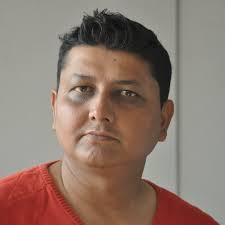
Born in Kathmandu, Adhikari, 42, comes from a family whose members neither represent the music industry of Nepal nor do they have military background. Adhikari loved writing poems since his childhood. When he became the first person to receive a gold medal from the hands of Rashtrakavi Madhav Prasad Ghimire in the first Nationwide Poem Competition while he was in class nine, many already knew this that one day this talented child would transform into a promising lyricist to look up to. This prediction came true when he recorded his first song at Radio
Nepal in 1990 in which Bharat Raj Bhandari and Rachana Jisi lent their voices.
Fond of listening to the gazals written by Motiram Bhatta and Bhakta Raj Acharya, Adhikari always dreamt of being one like them. While many say that army personnel are more rational and hardly care much about being emotional, Adhikari has demonstrated that it was his place in Nepal Army which actually enabled him able to write songs powerfully because as an ascending senior officer, he got the opportunity to understand true Nepali cultures and lifestyles more closely.

“On the battlefield, I make sure that I’m a complete soldier and I do my job responsibly. In the meantime, I have this emotional guy within me who experiences all sorts of feelings like pain, joy, and cruelty. These feelings combine to make me start writing,” says the lyricist who has given hit numbers one after the other and has worked with almost all singers who are the who’s who of Nepali music industry.
In fact, some of his lyrics have helped many establish themselves as singers. Take for example, the popular song Orali Lageko Harinko Chal Bho sung by Ram Krishna Dhakal.
This particular song written by Adhikari took Dhakal to newer heights of fame and success. One after the other, Dhakal sang Adhikari’s other creations like Daiba Tero Mayako Khelale and Hira Katne Hiraima Rakhera – all made it big on the music charts for months. Likewise, Adhikari’s other songs like Yo Kanchhiko Aansu Ho Ki Fewa Taalko Paani, Mann Rahepo Maya Priti and Asaiko Bhumarile Khayo Mero Kalilo Mann helped singer Yam Baral get recognition in the field. With other singers as well, from Ishwar Amatya to Ananda Karki, Sharmila Bardewa, Satya Swaroop Acharya, Uday/Manila Sotang, Sapana Shree, and Narendra Pyasi, Adhikari has worked in various genres, and with more than a dozen prominent Nepali music composers.
With almost a dozen albums released under his belt, Adhikari’s recent release “Ekadeshma: Once Upon a Time” is a beautiful offering of powerful lyrics combined potently with the music composition of Raju Singh and arrangement by Maharaj Thapa. What make his songs even better are the voices lent to his words. Veteran singers such as Ram Krishna Dhakal, Rajesh Payal Rai, Anju Panta, Yam Baral, Satya Raj Acharya, Swaroop Raj Acharya, Uday Sotang, Manila Sotang, and Jagdish Samal have complimented beautifully to lyrics written by Adhikari.
“Ekadeshma: Once Upon a Time” is one of Adhikari’s own favorite albums because it is dedicated to his grandmother.
“My grandma is an Alzheimer patient. She’s over 95 now, and we must recognize her ourselves every single day. After contracting the disease, she lost her memory almost completely. But what surprises me is that she still has her childhood memories left in her mind and she keeps on telling us her childhood stories. It feels like listening to a fairytale of Ekadeshma: Once Upon a Time,” Adhikari went nostalgic as he related the story behind the title of his album.
It would not be wrong to call this lyricist-turned-soldier a versatile artist for he is a double graduate in Disaster Management and International Relationship, and will soon earn another degree in Rural Development.
With his other musical projects in the pipeline, Adhikari is sad to realize how lyricists from among the younger generation have taken this field like a “fast food” business.
“The songs released in recent times are short-lived because the people concerned don’t dedicate themselves soulfully. Every song must have certain philosophy. Sadly, people are more interested in coming up with music videos than concentrating on lyrics and composition. Do you think Narayan Gopal’s songs need music videos to make them popular?” He questioned and concluded, “One should make sure that s/he doesn’t expect anything in return if s/he decides to become an artiste. In the art field, it’s your soulful satisfaction that comes in the very beginning. If you’re expecting material gains in return, you turn out to be a pure businessman selling creativity, and not producing them.”
Related story
'Pen-Pineapple-Apple-Pen' singer unveils extended version of vi...