ITAHARI, Oct 28: It was around 9 pm. Rabin Khadka of Itahari Sub-Metropolitan City-2 had already gone to bed when villagers began shouting, “Elephants are here! Elephants are here!” He woke up and rushed outside. His family tried to stop him, warning that chasing the elephants could be dangerous. But the 26-year-old decided to join his friends in driving them away. They headed towards the Taltalaiya area near his home. It was to be his final journey.
There were not just one or two elephants but a herd of 20–25 wild elephants in the Taltalaiya area. As the animals approached the settlement, local youths gathered to drive them back into the forest. The group managed to push them some distance away, and the danger appeared to have subsided. But one elephant turned back and charged at Rabin. He was killed on the spot and never returned home.
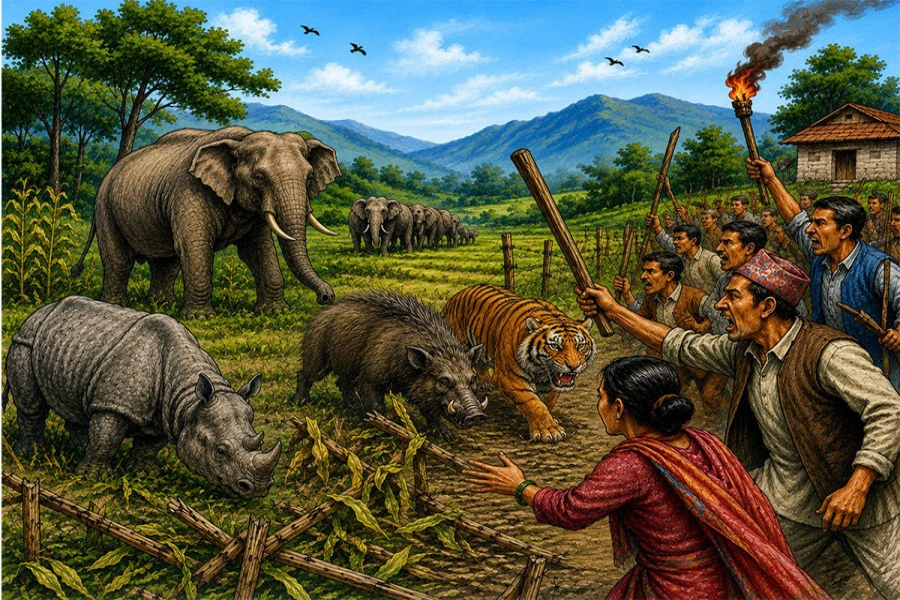
The incident on November 29, 2023, was more than the death of a young man. It illustrated the growing conflict between humans and wildlife as the boundary between settlements and forests continues to shrink. People try to protect their homes and crops, while elephants seek to return to their habitats and traditional routes. When their paths cross, people can lose their lives.
Rabin used to travel abroad for foreign employment. He had been married for barely a year when the elephant killed him. His son was born 45 days after his death. Rabin's wife, Renuka, said her heart breaks whenever their son asks why other children have fathers but he does not.
Renuka, a daughter of the Rai community, and Rabin, a Chhetri, had married for love. Losing her husband within a year of their marriage left her unconscious for days. “I don't remember anything that happened after his death. I was also physically unwell at the time,” she said. The federal government provided the bereaved family Rs 1 million in compensation, while Itahari Sub-Metropolitan City provided another Rs 100,000.
As the distance between elephant habitats and human settlements narrows, encounters have become increasingly deadly. In 2014, 12-year-old Sangeet Kumari Yadav of Saptakoshi Municipality-10 in Saptari was killed on the spot in a wild elephant attack. That same year, 12-year-old Suman Limbu of the then Bharoul VDC-3 in Sunsari was killed while collecting grass and firewood in the forest. Five others who had accompanied him were injured. In the same year, Dhasina Khatun of Madhuban, Sunsari, and 55-year-old Bholiyadevi Mukhiya of Haripur Municipality-3, Sunsari, also died in wild elephant attacks.
In June 2018, 50-year-old Bhumiya Devi Chaudhary of Barahakshetra Municipality-9 in Sunsari was seriously injured when an elephant attacked her while she was sleeping in a buffalo shed. She died during treatment. A few months later, in 2019, 50-year-old Buddhiman Magar of Belaka Municipality-3 in Udayapur was fatally injured when an elephant attacked him as he returned home after grazing cattle. He also died during treatment.
Twist of fate: Wild elephant invades Elephant Festival

These incidents highlight the severity of human-elephant conflict in settlements near forests in eastern Nepal. While people face growing risks, the incidents underscore the need for long-term solutions that protect both local residents and elephants. Protecting elephant habitats and migration routes, introducing early-warning systems in high-risk areas and strengthening local safety measures could help reduce casualties and property damage. Elephants from the Charkose forest stretching from Udayapur to Jhapa frequently enter settlements and damage crops, particularly during the paddy harvest season.
Humans are not the only victims of this conflict; elephants also die. In 2019, a wild elephant estimated to be around 25 years old, with thick tusks, was found dead near the eastern channel of the Koshi River in the Koshi Tappu Wildlife Reserve. In November 2020, another wild elephant died after becoming entangled in an electric wire in Kanchanrup Municipality-5, Saptari. A herd of elephants had entered a settlement and knocked down an electricity pole, leaving the animal caught in a live wire connected to it.
The Koshi Tappu Wildlife Reserve covers 175 square kilometres across Sunsari, Saptari and Udayapur. Although an electric fence has been installed along the Sunsari side to prevent elephants from entering settlements, similar fencing has not been installed along the Saptari and Udayapur sides. As a result, wild elephants continue to die in electrical traps in those areas.
In Jhapa, Morang, Sunsari, Udayapur and Saptari, a recurring cycle of deaths continues: elephants kill people, while people use various methods to kill elephants. Elephants are symbols of civilization, but human encroachment has increasingly threatened wildlife habitats. Elephants continue to die, while they also kill people, damage houses and sheds, and destroy crops. As the human population grows, forests are encroached upon and cleared, shrinking elephant habitats and roaming areas. People have also begun building homes along traditional elephant corridors, increasing encounters that leave both humans and wildlife increasingly vulnerable.
There are two species of elephants: African and Asian. Both male and female African elephants have tusks, while among Asian elephants, tusks are generally found only in males. Male elephants without tusks are called “Makuna” in Nepal. These elephants are said to cause more destruction than others. Elephant attacks have increasingly claimed human lives and damaged crops.
Human-elephant conflict is intensifying across Koshi Province, particularly in Jhapa, Morang, Sunsari, Saptari and Udayapur. People continue to die in elephant attacks, while elephants are killed through electrocution, gunfire and other means.
According to Bhupraj Yadav, senior conservation officer at the Koshi Tappu Wildlife Reserve, 45 elephants have died in various parts of Koshi Province since fiscal year 2005/06. He shared the figures with journalists from Sunsari and Morang a few weeks ago.
The data show that 25 elephants have died in Jhapa since 2005. Six died in Koshi Tappu and surrounding areas between 2013 and 2022. Morang recorded eight elephant deaths since 2011, while Udayapur recorded two since 2012, Saptari two since 2020 and Sunsari two since 2022. Most of the elephants died from electrocution or gunfire, Yadav said.
Data for fiscal years 2023/24 to 2025/26 show that human-elephant conflict has become more complex rather than declining. According to the Koshi Province Forest Directorate, elephant attacks killed 31 people in the province during this period: 10 in 2023/24, 13 in 2024/25 and eight in 2025/26. Fifteen elephants also died during the same period.
Yogin Shrestha, information officer at the directorate, said elephant attacks had killed 49 people in Koshi Province before fiscal year 2018/19 and another 58 since then.
Elephants have also caused extensive damage to crops, houses, sheds and other property. The directorate said the government provides compensation for such losses, with payouts rising significantly in recent years. Compensation totalled Rs 829,928 in fiscal year 2023/24, Rs 22.715 million in 2024/25 and Rs 26.851542 million in 2025/26.
A total of Rs 132.817 million has been distributed in relief to wild elephant victims in Koshi Province to date. As settlements have become denser along traditional elephant routes, growing human activity has increased damage caused by elephants. A decline in food availability inside forests, combined with abundant food in settlements, has also encouraged elephants to enter populated areas.
Jhapa has suffered the greatest damage, although elephants have also caused losses in Morang, Sunsari, Udayapur and the lower areas of Ilam.
Despite discussions and various announcements by regulatory bodies to reduce the threat posed by elephants, many initiatives have remained confined to discussions. Crop destruction, damage to houses and sheds, and human casualties caused by wild elephants continue in Jhapa, Morang and Sunsari. As the Tarai-Chure belt from Ilam to Udayapur has increasingly become a destination for elephants, the geographical reach of human-wildlife conflict has widened.
The government's main immediate response to human-wildlife conflict has been relief and compensation. The Wildlife Damage Relief Distribution Guidelines, 2023, are currently in force. They provide Rs 1 million to the family of a person killed in an elephant attack, relief to injured people depending on the severity of their injuries, and compensation within prescribed limits for damage to houses, sheds, crops and stored grain.
In recent years, the Koshi provincial government has begun prioritising “human-elephant coexistence” over simply controlling elephants. Since fiscal year 2024/25, it has allocated budgets for programmes addressing human-wildlife conflict in Jhapa, Morang, Sunsari and other districts. These include wildlife conservation, ecotourism, relief and compensation, and crop insurance. However, the initiatives have yet to deliver the expected results.
Ashok Subedi, a senior officer at the National Trust for Nature Conservation, said elephants and monkeys are among the more intelligent wild animals and must be managed using appropriate methods. Elephants particularly like bananas and sugarcane. Subedi suggested using suitable substances that make these foods taste unpleasant in areas where elephants are attracted to them. He said recommendations on such substances had also been submitted to the government.
Nepal has 292 wild elephants. According to elephant expert Ashok Ram, 65 elephants roam around the Charkose forest area in Koshi Province.