



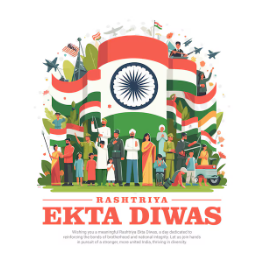
Every October 31, India celebrates Rashtriya Ekta Diwas, National Unity Day, to honour the birth anniversary of Sardar Vallabhbhai Patel, the man who stitched together the newly independent nation in 1947. Yet Patel’s vision was never confined to India alone. His belief in cooperation among diverse communities and in federal strength built through dialogue holds deep meaning for South Asia as a whole, especially for Nepal, India’s closest neighbour in geography, history, and sentiment.
The Statesman Who Forged India’s Oneness
When the British left the subcontinent, they left behind more than 560 princely states. Patel, India’s first Deputy Prime Minister, undertook the herculean task of integrating them into one Union. Through a mix of diplomacy, foresight, and firmness, he brought together regions as varied as Hyderabad, Junagadh, and Jammu & Kashmir, shaping a map that reflected unity amid difference.
Patel’s words still echo across borders: “Manpower without unity is not a strength unless it is harmonized and united properly; then it becomes a spiritual power.” This “spiritual power” of harmony is equally relevant to Nepal, whose multi-ethnic, multi-lingual society has long balanced mountain and plains, faith and philosophy, monarchy and republic, always searching for cohesion in diversity.
Why Ekta Diwas Matters Beyond India
Madhesh province government to celebrate Swabhiman Diwas on Jan...

Since 2014, Rashtriya Ekta Diwas has been observed nationwide in India to rekindle Patel’s vision of Ek Bharat, Shreshtha Bharat, One India, Great India. From schoolchildren in Sikkim to soldiers in Ladakh, millions join Run for Unity events and take oaths to uphold integrity and brotherhood.
For Nepal, which shares an open border and ancient cultural bonds with India, this celebration offers inspiration rather than imitation. Both nations are heirs to the same civilizational ecosystem—the Himalayas, the Ganga basin, the philosophies of Buddha and Adi Shankaracharya. The idea that unity strengthens sovereignty, rather than threatening it, is as vital for Kathmandu as it is for New Delhi. In an age of political polarization and social media echo chambers, Ekta Diwas reminds all South Asians that stability flows from inclusiveness.
Shared Lessons for a Shared Neighbourhood
Sardar Patel believed that unity was not uniformity but cooperation. He saw diversity as India’s genius, not its weakness. That principle could well be applied to Nepal’s ongoing democratic journey, where inclusion of hill, Terai, Janajati, Madhesi, and Dalit voices remains key to long-term harmony.
Likewise, regional partnerships between India and Nepal—be it in hydropower, climate resilience, or cultural tourism—are strongest when built on the same spirit of mutual respect Patel championed. The Statue of Unity in Gujarat, the world’s tallest at 182 metres, is not only an Indian monument; it stands as a South Asian symbol of what cooperative federalism and people-to-people trust can achieve.
The Himalayan Call for Unity
As the region faces trans-border challenges, migration, environmental degradation, and economic disparity, the ethos of Ekta Diwas becomes a common call to action. It urges nations to look beyond politics and rediscover their moral interdependence. Patel’s reminder to “take the path of Dharma—the path of truth and justice” resonates in Nepal’s plural democracy, where balancing rapid modernization with age-old values remains a national quest.
For ordinary citizens, from the farmers of the Terai to the youth of Pokhara, unity is not an abstract slogan. It means working together for shared prosperity, safeguarding cultural heritage, and ensuring no community feels left behind.
A Legacy That Crosses Borders
Patel’s dream, “that no one should be hungry, shedding tears for food,” captures a humanitarian vision familiar to Nepali thinkers from B.P. Koirala to today’s social reformers. It is a reminder that unity is not built by speeches but by service, by making sure growth and dignity reach every household.
When India celebrates Ekta Diwas, its message naturally extends to Nepal and the wider Himalayan region: enduring peace and progress are possible only when societies choose solidarity over division. Patel’s ideal lives on not only in the plains of Gujarat but also in the mountain air that both nations share.
One Region, One Spirit
As India marks Rashtriya Ekta Diwas this October 31, it invites its neighbours to see unity as a shared South Asian strength. Borders may define sovereignty, but the spirit of togetherness defines civilisation. From the Statue of Unity on the Narmada to the stupas of Lumbini, the message is the same: diversity is destiny when bound by understanding.





