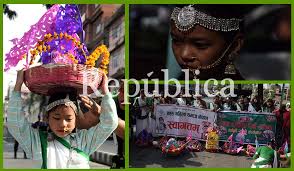
JANAKPURDHAM, Nov 14: The Sama-Chakewa festival, a symbol of love, goodwill and affection between brothers and sisters, has begun in the Mithila region.
The festival begins on Kattik Shukla Panchami, the fifth day of the bright fortnight of Kattik, and continues for 10 days, concluding on the 11th day, or the night of the full moon.
Sisters and daughters in the Mithila region gather in groups to sing and dance traditionally, praying for the happiness, prosperity and long life of their brothers.
Promoting Mithila Art

According to Pundit Ram Kumar Shastri, a scholar of the festival, sisters and daughters visit open areas and paddy fields outside their villages to collect mud dug out by their brothers on the first day of the festival. They mix the mud with water and make various figures of Sama and Chakewa.
The figures are placed in red bamboo baskets and lamps are lit. At night, women carry the baskets to village squares, crossroads, junctions, schools, public rest houses, temples and Chhath ghats, where they perform traditional songs and dances.
The festivities continue for 10 days as sisters pray for the long life of their brothers. On the morning of the 11th day, new Sama-Chakewa figures are made and painted. In the evening, after serving dahi-chiura (yogurt and beaten rice) to their brothers, women perform the traditional phanr bharne ritual.
The brothers then break the Sama-Chakewa figures. The figures are finally immersed ceremonially amid music, singing and dancing, marking the conclusion of the festival.
Traditionally, married women return to their maternal homes to celebrate Sama-Chakewa. Even those living far away travel to their parents' homes to join the festivities.
The festival is celebrated with great enthusiasm in Mahottari, Sarlahi, Siraha, Dhanusha, Saptari, Bara and Parsa districts of Madhesh Province, as well as in the bordering districts of India.