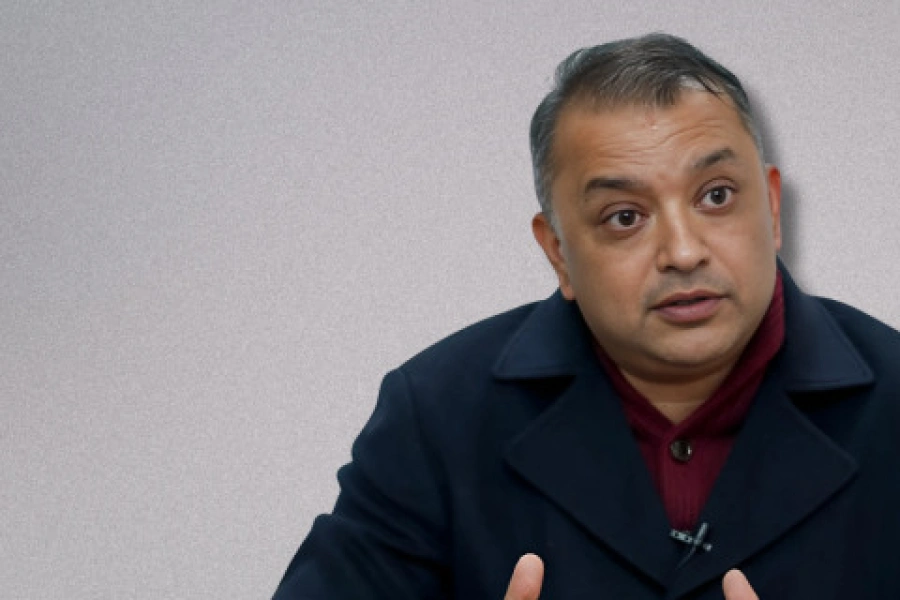
These days Baburam Bhattarai looks increasingly like Siddhartha, the prince who went on to become Gautama Buddha.
Siddhartha renounced his wealth, power and luxury in search of a new way of life that would free people from suffering. After a number of different attempts at enlightenment, his awakening allowed him to offer a moderate path of renunciation of excesses. He became Gautama Buddha.Baburam Bhattarai, former prime minister and until recently a key leader of UCPN (Maoist), resigned from the Constituent Assembly and his party immediately after the constitution was proclaimed. Much like Siddhartha, Bhattarai is now in a quest to discover a new way of life that will free Nepalis from political suffering. He currently wanders across Nepal in search of an awakening.
The similarities between Bhattarai and Siddhartha are striking.
When Siddhartha set out from his palace secretly in the middle of night, it is said that the Gods muffled the hooves of the horses so that no one would hear him leave. Similarly, Bhattarai left so stealthily and abruptly after the constitution was proclaimed, it is said that even the Maoist Gods didn't hear him leave.
When prince Siddhartha was born, his father (the king) called eight of the most prominent sages of the time and had them announce Siddhartha's future. They decreed that Siddhartha would go on to be a great man. Similarly, long before Bhattarai become a great Maoist leader and prime minister, he was already anointed to be a great man—a topper in board exams, a topper in college, a topper in India's leading architecture school and as PhD student produced one of the most widely read dissertations.
When Siddhartha's father, the king, learned that his son might go on to be Buddha, he built four great palaces for his son with the intent of shielding him from every conceivable human suffering. No one built four palaces for Bhattarai. But as a Maoist leader and later while in power, he did similarly enjoy a life shielded from many conceivable elements of human suffering.
Deep in the hills and forests of Nepal, Bhattarai, like Siddhartha, lived the protected life of a highly placed Maoist ideologue. In the front-lines of his insurgency, thousands of Nepali men and women gave their lives so that he could be protected and could go on to become a great man. After Bhattarai became prime minister, he similarly lived, like Siddhartha, shielded from the pains of ordinary citizens who had their aspirations of a constitution dashed but who nonetheless tore down their walls and houses so that he could widen the roads in Kathmandu.
After renouncing his life as a prince, Siddhartha wandered from place to place, experimenting with different ways of life and modes of enquiry. Bhattarai similarly wanders across Nepal exploring different issues and communities.
On Sunday November 22nd, he unveiled a two-day think session for a "new power." He has said he is seeking to forge a new power that will focus on economic development but what he is really after is enlightenment—he just doesn't know it yet. Siddhartha also never realized he was on a quest for enlightenment till he perched himself under a Bodhi tree for 49 days.
The question is whether Bhattarai, like Siddhartha, has the courage to accept what he will find.
Like Buddha, Bhattarai will discover what he needs is 'renunciation.'
What Nepal needs is an awakened, enlightened individual who renounces political power and is prepared to sacrifice his life in leading a good, honest civilian life. We need a civilian leader for a civil society—not another political power.
There are 122 registered political parties in Nepal. Bhattarai's new power, if it is a political party, will be the 123rd. It is hard to imagine that there is even a tiny bit of ideological space left that is not already taken by one of the 122 existing parties. What will the 123rd political party add to the rat race for political power?
The existence of the 122 registered parties and the fractured polity of our times is a clear sign of how deeply the political decay has infected our civilian life. There is no civilian life left—everything is about political and economic power.
Politics pervades our everyday life. From getting our children to school, starting our careers, getting married, having children and running a business to simply living, everything is now tied to whom we know. The simplest of tasks requires us to first think of a connection we have. We enter a bank and first seek out whom we know. We go to the movie having first called our uncle, aunt, friend—whomever—for a ticket beforehand. Going to a government office without first knowing someone there is like diving into quicksand.
The need to access political influence has become an instinctive Pavlovian reaction. As politics is pervasive, access to influence has become the very basis for survival. As much as we teach our children to differentiate between good and bad, we also have to teach them about who has access to power and who doesn't.
The encroachment of politics into civilian life began a long time ago when politicians began straying beyond their remit and influencing everyday life. But the decay really set in when our institutions, which should have acted as counterweight to the overreach of politicians, began crumbling.
There is not a single sector that has withstood political encroachment. Whether it is justice, sports, arts, administration, culture, business, education or religion, political influence is thorough and complete. Institutions have crumbled one by one, a reflection of the political decay. The last bastion for sanctity—our simple civilian way of life in the strength of our families and privacy of our homes—has also fallen to the colonizing army of political decay.
The reason that we now despair in Nepal is that there isn't even a civil society left on which we could peg our last hope.
Against this backdrop, Bhattarai's quest for enlightenment takes on special meaning. For our sake more than for his, we hope he succeeds. But if his goal is to unleash a "new power" that will allow him to regain political supremacy, no matter how genuinely motivated it is, we are all doomed.
When Siddhartha left his palace, he left all his worldly pleasures behind. He would return to the palace only once, much later and as Gautama Buddha. His complete and thorough renunciation of worldly desires was in part the basis of his path to enlightenment and the teachings he offered the world.
Does Bhattarai have the courage to be Buddha? Could he, like Siddhartha, renounce his claim to political power to lead the resurgence of ordinary civilian life so that the people of Nepal can reclaim their civilian lives and live with peace and dignity?
bishal_thapa@hotmail.com
Related story
‘Private transport is not a luxury sector’