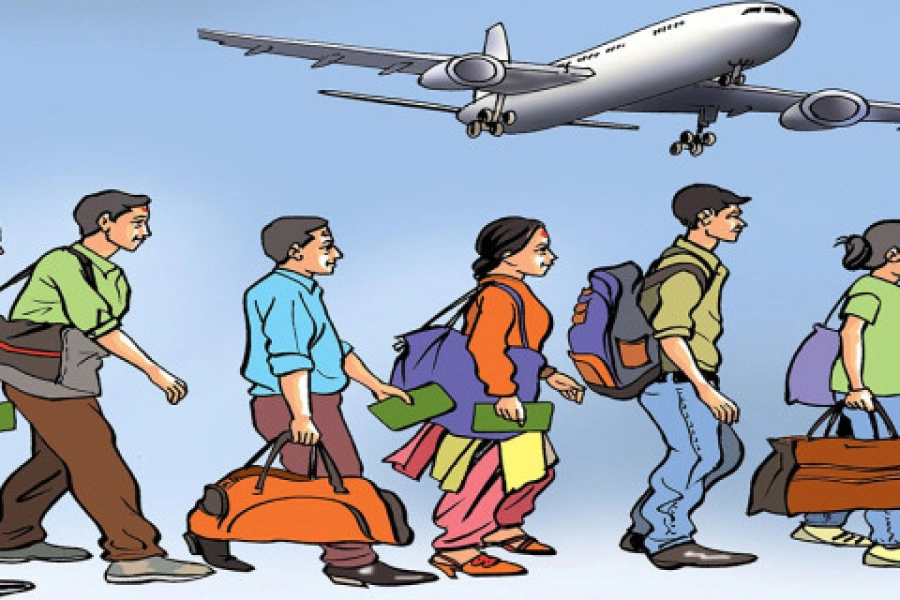
Nepal's migration economy is often narrated as a success story, and by conventional metrics, it is. Remittances totaled Rs 1,659.41 billion in the first nine months of 2025/26 - a 39.1 percent increase with a single-month peak of Rs 209.75 billion in mid-April 2026. Net Foreign Assets expanded by Rs. 731.16 billion, a 27.4 percent surge, and the balance of payments remains firmly in surplus. With 4.4 million Nepalis currently employed abroad, labor migration has served as the country's primary macroeconomic stabilizer for decades, cushioning fiscal deficits, underwriting imports, and sustaining household consumption in provinces where domestic employment is scarce.
But macroeconomic stabilizers can become dependencies, and dependencies carry risk. Nepal’s migration governance is generous in exporting labor and negligent in absorbing its consequences. This is an asymmetry that is not accidental, but architectural, a system designed around departure, not arrival. As the nation has postponed graduation from Least Developed Country (LDC) status to November 2029, two structural faults deserve far more scrutiny than they receive: the complete absence of destination-country employer contributions to Nepal's Social Security Fund (SSF), and the hollowed-out reality of the "Free Visa, Free Ticket" policy. Together, they reveal a system that extracts maximum value from Nepali workers while distributing the long-term costs entirely back to the state and its citizens.
The Nepal Labor Migration Report 2024 makes the unevenness plain. While aggregate remittances broke records, the distribution remains sharply skewed: households in Koshi, Gandaki, and Bagmati receive an average of over NPR 240,000 annually, nearly triple what families in Sudurpaschim and Karnali see. A national income stream this concentrated is not board-based growth; it is a transfer mechanism with deep geographic fault lines.
The SSF Mirage
Will Covid-19 make us humane?

Some 2.2 million Nepali migrants are enrolled in the SSF, a contribution-based scheme promising accident, disability, and old-age coverage. But the scheme contains a fundamental design flaw. Enrollment is mandatory for labor approval, requiring workers to make at least one month’s contribution - 21.33 percent of a nominal base salary, before they can leave the country. The entire contribution burden rests solely on the worker. No destination-country employer pays a single rupee. Unlike domestic employment, where SSF mandates a shared contribution (20 percent employer, 11 percent employee), the migrant model inverts the logic entirely: those who bear the greatest occupational risk subsidize their own safety net with no reciprocal obligation from the entities that profit from their labor. Those who stop contributing after that initial payment - as the vast majority do - are classified as “discontinued” contributors, enrolled in name but unprotected in practice.
The Labor Migration Report 2024 confirms the scale of disengagement: only around 1.6 percent of enrolled migrant workers have continued contributing to their SSF accounts, with virtually identical rates among men (1.6 percent) and women (1.5 percent). Women bear an additional layer of this burden. Female migration has grown significantly and faces a separate, weaker legal regime, with domestic workers remaining excluded from standard labor protections in most Gulf states. This is not a functioning social contract - it is a toll for departure, compounded by persistent gaps in awareness that leave most workers unable to grasp what the SSF offers or why sustained contributions matter.
The health consequences make this cost transfer visceral. Kidney disease, respiratory illness, and hearing loss are predictable consequences of years of extreme heat and chemical exposure in the Gulf and Malaysia, where 80 percent of Nepal's labor approvals are concentrated. Migrants are often covered by employer health insurance only for the first year abroad. Employers routinely treat injured or sick workers as liabilities, sending them home rather than covering treatment. The worker arrives back in Nepal with a chronic condition, no employer-side coverage, and no systematic health screening awaits them at Tribhuvan International Airport.
Approximately 1,000 Nepali workers die abroad each year. In fiscal year 2024/25, 1,401 bodies were repatriated, the majority aged 26 to 40. Nearly 12 percent of those deaths are recorded as suicides. Nepal's bilateral labor agreements must begin incorporating mandatory employer co-contributions to the SSF, or, at a minimum, portability mechanisms that ensure benefits earned abroad follow the worker home, not just for illness.
The "Free Visa, Free Ticket" Fiction.
Introduced in July 2015, the “Free Visa, Free Ticket” (FVFT) policy was designed to shift visa and airfare costs from workers to destination-country employers across seven Gulf states and Malaysia. In principle, it was a landmark assault on debt bondage. In practice, the ILO's recruitment profile for Nepal reveals that only 7 percent of workers operate under a genuine "employer-pay" model. The policy contains its own escape hatch: if an employer refuses to pay, the recruitment agency may pass the cost back to the worker. This loophole has swallowed the rule. Workers continue to pay NPR 70,000 to well over NPR 150,000 in combined costs, often financed through high-interest loans that lock them into exploitative employment to service the debt. A policy that promises zero-cost migration while presiding over a system in which 93 percent of workers still pay is not a policy failure; after eleven years, it is a policy fiction.
The Common Thread
The two issues discussed above are expressions of the same structural logic. The painful costs of migration, including the recruitment debt, occupational damage, and broken health, are borne entirely by workers and their families, while the value is captured elsewhere. Workers pay to leave, pay again through uncompensated occupational risk abroad, and pay a third time upon return through healthcare costs neither their foreign employers nor the state has provided for.
Over 91 percent of the outbound workforce remains in low-tier categories. The ILO warns that LDC graduation could jeopardize 132,000 domestic jobs, making migration increasingly unavoidable for many households. If Nepal is serious about building a value-adding economy, reform must operate on two fronts: renegotiating bilateral agreements to include mandatory employer SSF contributions and replacing the FVFT with an enforceable employer-pay mechanism backed by joint liability. The architecture for this is not theoretical; the Philippines Overseas Workers Welfare Administration operates a welfare fund that draws a mandatory USD 25 per contract from workers, employers, or recruitment agencies alike. The amounts are modest; the principle is not. It establishes a tripartite obligation in which the employer, not just the worker, carries the cost of the risk. Hence, Nepal needs its own version of that compact.