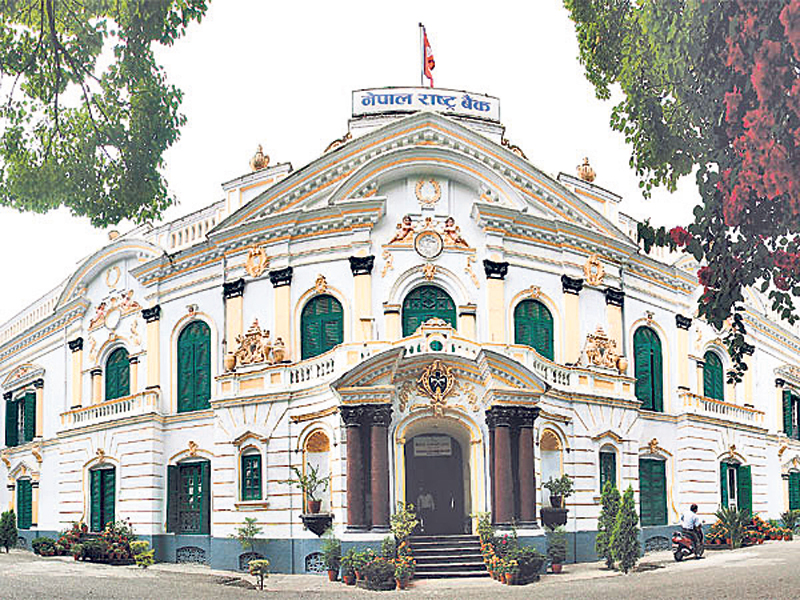
The central bank has mainly reckoned absence of adequate manpower, which emanated due to lack of fresh recruits over the past few years, contrary to sharp jump in number of financial institutions, as a major factor that jeopardized its inspection and supervisory capacity.[break]
“We are bridging this gap by recruiting 25 officers and 50 assistants in the near future,” NRB Governor Dr Yuba Raj Khatiwada told Republica on Tuesday.
The central bank is also planning to recruit additional chartered accountants to beef up its inspection and supervisory role. It is also mulling over separating inspection and supervision desks for development banks and finance companies. Presently, it has a separate department to oversee operations of 31 commercial banks, but monitoring and supervision of more than 170 financial institutions rests on the Finance Supervision Department (FSD).
“Clearly, there is a work overload that needs to be rationalized for effective outcome,” Dr Khatiwada said, disclosing that the central bank was also coming up with new Supervision Manual to lay down uniformity in inspection process and corrective actions to be prescribed to banks and financial institutions.
The fresh human resource planning and departmental restructuring has been mooted mainly after the central bank realized that its inability to conduct regular and frequent onsite inspections in financial institutions was giving ample space for anomalies.
NRB presently has about 200 officials in bank supervision and finance supervision department. Considering the number of institutions, NRB has assessed that it needs at least 500 officials in those departments.
“No wonder, the central bank is facing difficulty in timely identifying the problems, checking irregularities, non-compliance and poor governance in the FIs,” said another NRB official.
Over the past six years, the number of category B development banks has more than tripled to 88 and also the number of category C finance companies has almost doubled to 89.
“However, the FSD has not got additional human resources,” said Dr Khatiwada.
As a result, the central bank that carries out onsite inspections in a scheduled manner has been approaching the same institutions for next inspection after a gap of some three years only.
That is a huge gap and one of the reasons why NRB itself is unaware of actual financial health of different FIs, said Khatiwada.
To do away with the situation, NRB from this year has arranged its FSD to conduct onsite inspection of all FIs at least once a year. This arrangement has compelled FIs to promptly comply with prudential directives. It has also dug out anomalies like poor governance, irregularities in loans and deposits management in FIs.
Recent declaration of Gurkha Development Bank as troubled bank and identification of irregularities by former executive chairman of Nepal Share Market and Finance were result of those initiatives.
That is not all. NRB officials said inspection teams have also found irregularities of varying extent in about a dozen financial institutions.
Such revelation has raised challenges for NRB to safely manage damages already done in the institutions. And the latest erosion of public confidence in the financial system, which could exacerbate the problems for the institutions, has only intensified challenges for the NRB.
Related story
Revised interest rate corridor system introduced