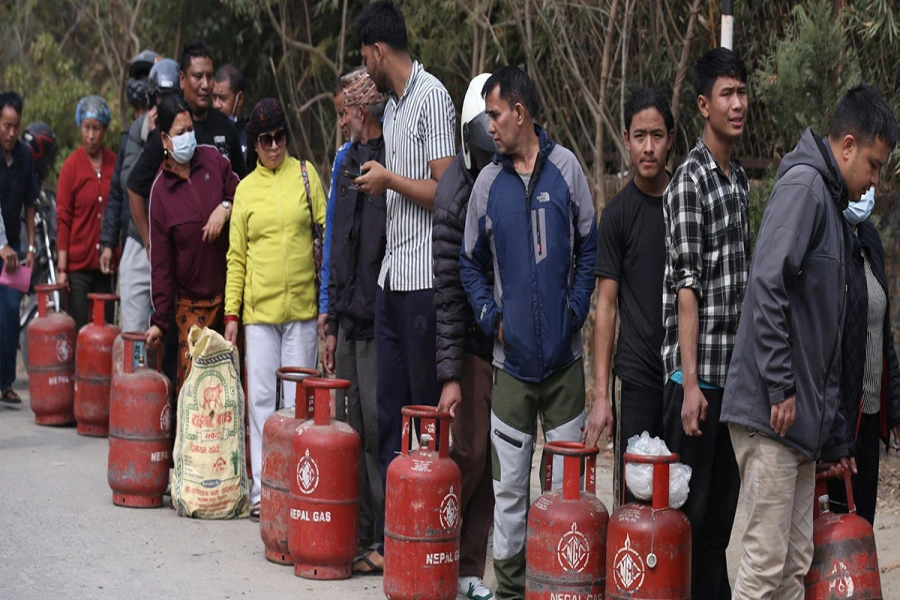
KATHMANDU, June 9: Consumers, LPG industries and distributors are bearing additional costs as the government's decision to sell only half-filled cooking gas cylinders remains in place despite the normalization of supply, with stakeholders estimating the policy has added nearly Rs 680 million in monthly expenses.
The arrangement was introduced in the second week of March amid concerns over a possible supply crisis caused by the conflict in West Asia. At the time, difficulties in importing liquefied petroleum gas (LPG) had led to shortages in the domestic market, prompting Nepal Oil Corporation (NOC) to allow the sale of only half-filled cylinders.
However, industry stakeholders say the supply situation has since returned to normal, with LPG being imported regularly from the Indian Oil Corporation (IOC) based on demand. Despite this, NOC has yet to review its decision and resume the sale of fully filled 14.2-kilogram cylinders, resulting in an estimated additional cost of nearly Rs 680 million per month.
According to the Nepal LP Gas Industry Association, consumers, industries and distributors are all incurring significant losses because the government has not reinstated the full-cylinder system.
Association President Diwan Bahadur Chand said transportation and management costs for half-filled and fully filled cylinders are essentially the same, causing operating expenses to soar.
"The management cost for a half-filled cylinder is the same as that of a full cylinder," Chand said. "The overall cost has nearly doubled."
He said a cylinder that would normally require one refill and delivery cycle now requires two separate refilling and transportation processes, effectively doubling costs. Chand added that LPG entrepreneurs have repeatedly requested NOC, secretaries at the Ministry of Industry, Commerce and Supplies, and the minister concerned to allow the sale of full cylinders, but their appeals have gone unanswered.
According to LPG industry operators, additional expenses are incurred during the filling, testing, distribution and transportation of half-filled cylinders. The operational cost remains almost identical to that of a full 14.2-kilogram cylinder.
Aviation fuel depot in Pokhara with an investment of Rs 680 mil...

The repeated handling and management of the same cylinder at different stages has increased both production and distribution costs. The burden is not limited to industries alone; distributors are also suffering losses. Businesses have been affected by the need to resupply customers more frequently, difficulties in stock management and increased transportation costs.
Consumers, too, are paying more. The delivery charge from distributors to households remains unchanged even when a cylinder contains only half the amount of gas.
Industry operators estimate that transporting a full cylinder costs Rs 45.88, and the same amount is spent on transporting a half-filled cylinder.
Similarly, the use of seals and caps costs Rs 7 per cylinder, while refilling costs Rs 11.50 per cylinder. LPG industries receive a commission of Rs 31.90 on a fully filled cylinder. Although the management cost of a half-filled cylinder is equal to that of a full cylinder, the commission paid to industries is only half.
Likewise, LPG distributors receive a commission of around Rs 58 for selling a full 14.2-kilogram cylinder. Under the half-cylinder arrangement, they receive only half that amount despite incurring the same expenses.
The average delivery cost from distributors to consumers' homes is about Rs 75 per cylinder. This cost also remains unchanged regardless of whether the cylinder is half-filled or fully filled.
Industry estimates show that the total expense from refilling gas to delivering it to consumers' homes is approximately Rs 229 per cylinder. This cost applies to a full cylinder and remains nearly the same for a half-filled one.
Although commissions paid to industries and distributors are reduced proportionately for half-filled cylinders, their operating costs remain unchanged. Excluding the cost of the gas itself and the cylinder, operational expenses are almost identical for both full and half cylinders.
As a result, the sale of half-filled cylinders has increased costs for everyone involved—from industries and distributors to consumers.
LPG industries supply around 100,000 cylinders to the market every day. Based on an estimated additional cost of Rs 229 per cylinder, unnecessary expenses amount to roughly Rs 22.9 million per day.
Over a 30-day period, this translates into an additional cost of approximately Rs 680 million. The extra financial burden is ultimately shared by consumers, distributors and industry operators alike.
Consumer rights advocates argue that with LPG supply now stable, the government should immediately resume the sale of fully filled cylinders.
Madhav Timilsina, president of the Consumer Rights Investigation Forum, said the half-cylinder policy has unnecessarily increased costs for consumers, industries and distributors.
"The half-cylinder system has doubled transportation costs," Timilsina said. "The government should immediately decide to allow the distribution of full cylinders in the market."
According to NOC, IOC is prepared to supply 49,500 metric tons of LPG every month, which is sufficient to meet domestic demand. The corporation stated that there is currently no obstacle to importing enough gas to distribute full cylinders.
Binit Mani Upadhyay, chief of NOC's LPG Department, acknowledged complaints from industry operators and distributors regarding the increased costs associated with the half-cylinder arrangement.
"We have informed the concerned ministry about the grievances raised by business operators," Upadhyay said.
NOC and LPG industries are ready to resume the sale of full cylinders if instructed by the ministry. However, stakeholders say the ministry's failure to address the issue has allowed hundreds of millions of rupees in additional costs to accumulate unnecessarily.
A fully filled LPG cylinder currently costs Rs 1,910, while a half-filled cylinder is being sold for Rs 955.