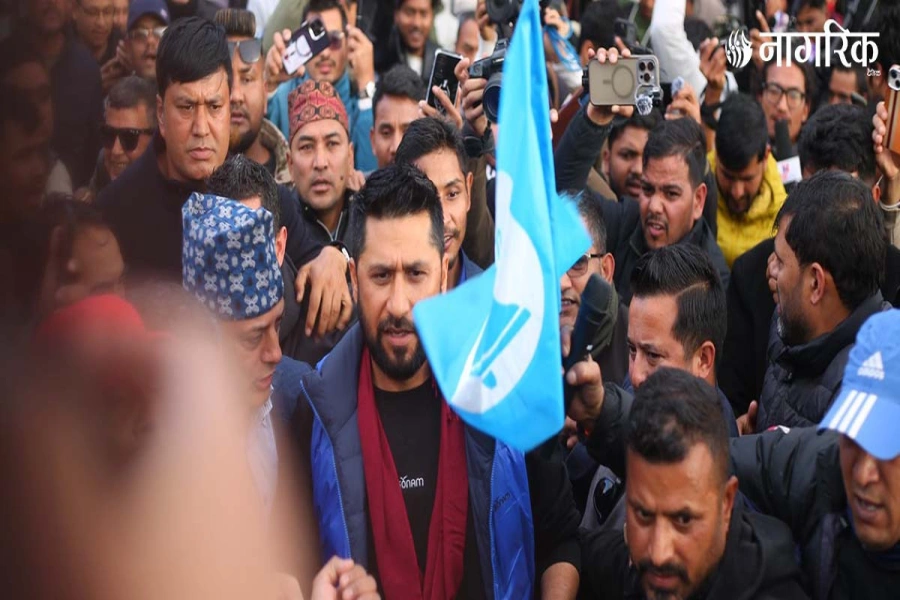
“Nearly 80 people had lost their lives from diarrhea, and medicine had yet to reach many villages,” said Shah, 41, a descendant of the rajas of Jajarkot, recalling that phone call.
"Nepal is a small country. It´s manageable," said Shah. "All we need is a few good men."
Preoccupation of the entire nation on the Maoist-led government´s attempt to sack then army chief Rookmangud Katawal; the consequent fall of the Maoist-led government in May; obsession thereafter of the entire nation on political exercises to form a new government; and finally time consumed by the new health minister to grasp the extent of tragedy in the midwestern region and launch a response cost Jajarkot and neighboring districts hundreds of lives.
 But Shah wouldn´t lose time. He immediately called up the health secretary, who informed him that the district´s harsh terrain and total absence of road infrastructure was making it difficult to take medicine from headquarters Khalanga to the villages.
Only three flights operate to Chaurjahari airfield in neighboring Rukum district a week. From there, one needs to trek for five hours to reach Khalanga.
“The epidemic was an offshoot of the state´s neglect of Jajarkot,” said Shah. “Poor infrastructure resulting from the same neglect hampered medical response to the outbreak,” he added.
Being a person who knew the district´s geography well, Shah offered to take care of transportation, and the secretary agreed to furnish him with medicine. Thereafter, Shah chartered a Fishtail Air chopper and left for Jajarkot where he dropped tons of medical supplies in seven health camps in two days.
But 10 days later, he was informed that despite availability of medical supplies, service delivery was ineffective in the lack of co-ordination.
“Service delivery is difficult when you have to trek for hours and then attend to thousands of patients in a single day,” he explained. Arranging accommodation and food for medical professionals, who had reached there to help, required people who knew the place and its people well.
Shah again chartered a chopper and left for Jajarkot, this time with 10 doctors from Alka Hospital, apart from two health assistants, two coordinators, and tons of medicine. Shah spent four days in Jajarkot and Rukum, helping ensure availability of medicine and doctors in the health camps set up by the government. He helped coordinate the response by cobbling together the Jajarkot Cholera Disaster Coordination Committee mobilizing the district´s youths.
The two trips cost Shah´s pockets about two million rupees, apart from assistance given to him by friends.
But Shah, who has considerable holdings in Kathmandu, calls it a “small sum” and his effort “tiny”. He believes it´s time to give back to the poor of the country and argues that small contributions can help districts like Jajarkot develop resilience, and the ability to fight back at such menaces.
“Cholera outbreaks are common in Kathmandu as well. But Kathmandu has medicine and doctors to respond in time. Jajarkot doesn´t,” said Shah, explaining the epidemic that cost nearly 400 lives.
Jajarkot Connection

The kingship of Jajarkot was one of the few that survived after Prithvi Narayan Shah´s unification campaign.
It is believed that an 18th century king of Jajarkot took a holy dip in the Ganges in Banares with Prithvi Narayan Shah and entered into a pact of friendship, ensuring the longevity of Jajarkot´s royals.
The rajas of Jajarkot used to enjoy state allowance until Captain Raja Prakash Bikram Shah, the last raja of Jajarkot, died in May 2003. The tradition died out thereafter as his successor was never named the new raja of Jajarkot. The naming had to be done by the “big raja” of Kathmandu.
“My great grandfather Hari Bikram Shah, the youngest of seven sons of a king of Jajarkot, came to Kathmandu in the early 1900s during the Rana rule,” said Shah.
The family got settled for good in Kathmandu after Hari Bikram´s daughter Bal Kumari was married to Chandra Shumsher, the fifth Rana prime minister.
The pace of development in Jajarkot is exemplified by the fact that a suspension bridge built back then under the initiative of Bal Kumari over the Bheri River still serves as the district´s major lifeline. And a 15-bed Jajarkot hospital built with funding from the government of the Netherlands decades ago and pushed into operation by Shah´s mother, is still the best hope for the residents of the district.
“There are no roads. Water supply infrastructure is pathetic. There is no opportunity. Most villagers are still living in the 18th or 19th century,” he said.
Shah believes people like him can make real difference by giving back to the poor.
“I really mean it from my heart,” said Shah, reasoning that wealth holds no meaning if all opportunities of the country are concentrated in a few urban centers where one gets stuck in traffic jams as soon as one steps out of the house.
Now associated with the Nepali Congress, Shah, however, doesn´t have a high opinion of the country´s politics or politicians.
“We need responsible politics,” he said, and explained his association with politics thus, “I am a social worker. But one can do only so much as a social worker. That´s why I joined politics.”
Shah says allegations mounted on the quality of food supplied by the UN World Food Program that feeds 57 percent of the population in the district are ill-founded. “Cholera is a water-borne disease. Bad food causes indigestion, but not cholera,” he said, terming the allegations “irresponsible” and dangerous to the food security of the people living in Jajarkot and neighboring districts.
Nepalese people demand so little, Shah says, and it requires very little from people in responsible positions to deliver that. “In districts like Jajarkot, basic amenities will suffice,” he said.
Encouraged by appreciation of his efforts in Jajarkot, Shah, who has also been helping expand educational opportunities for poor children in Jajarkot, has set up a Rs 10 million Kumari Trust and is launching a health awareness campaign in the district.
He is also ready to manage the hospital in Jajarkot on his own if the government gives permission.
“Nepal is a small country. It´s manageable,” said Shah. “All we need is a few good men.”
bikash@myrepublica.com
Related story
No limitation to beauty